
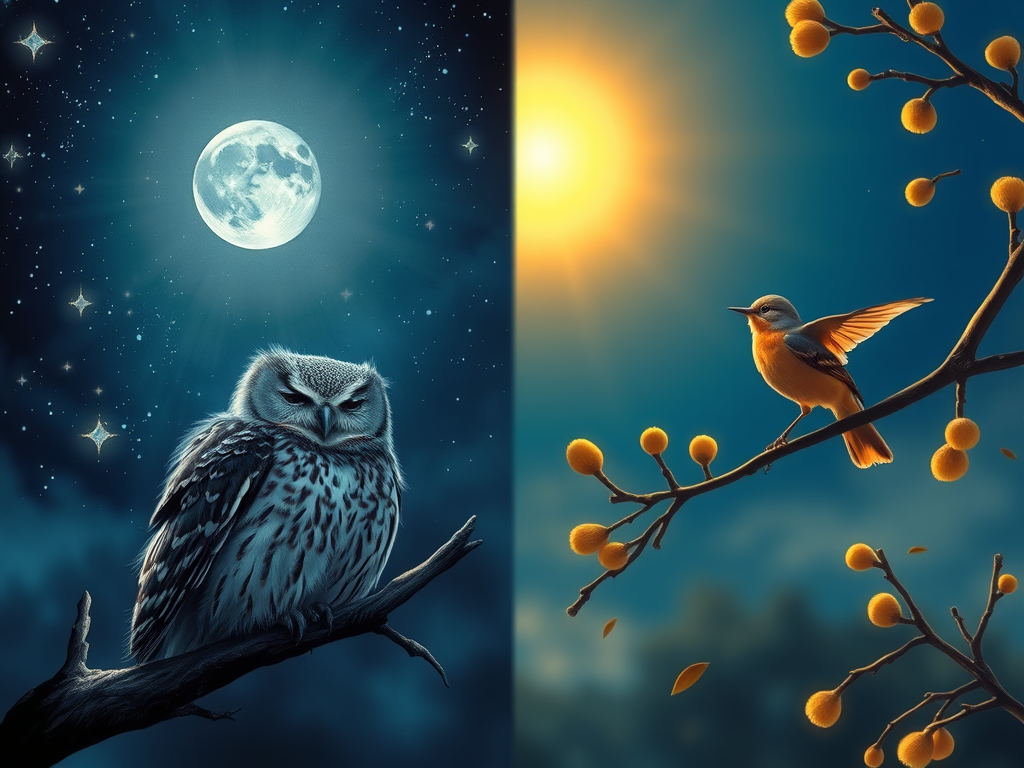

I was born to be a night owl—literally. In fact, I came into this world kicking and screaming at 3:02 a.m. I rarely go to bed before midnight. For most of my childhood and adult life, I’ve always had an innate inclination to stay up late. Late is a relative term depending on your schedule, but in my case, it was often past 11:30 on school nights. I remember on more than one occasion my mom telling me I needed to go to bed soon: “Don’t stay up watching Johnny Carson and David Letterman!” Unlike most kids, I never had a set bedtime. By the time I was in high school, it was 1 or 2 a.m. I was tired all day and then would take a 2-hour nap after school—not something I would recommend. I always had a twinge of guilt. I felt like a rebel in a world of subscribers to Ben Franklin’s “Early to bed, early to rise…” admonition. Funny, I’ve met many people who were early risers that I wouldn’t describe as healthy, wealthy or wise!
Although I love to work out, I will never in my wildest dreams be one of those people who leaps out of bed at 6 a.m. to bang out a round of burpees. Turns out, bears like me tend to be afternoon exercisers, and although you read a lot about the benefits of a morning workout, a recent Healthline article cited studies that show afternoon and evening workouts have their own advantages, such as increased reaction time, optimal muscle function and strength, and higher endurance
Like many people who have been labeled “night owls,” I have always felt somehow morally inferior to those people who—well, bang out burpees at 6 a.m. But here’s the kicker: Despite my lifelong tendency to stay up late, I still—gasp!—love mornings. I love to have my morning coffee or tea and my “Quiet Time” to think, pray, meditate and set some intentions for the day. I love to hear the birds singing. Although love the idea of watching a sunrise, I rarely do. But hey, that’s what YouTube videos are for.
It got me to wondering if it is possible to be both a morning person and a night owl. At the time, I thought those were the only “options” that existed. Then, a few months ago, I watched a podcast that confirmed my suspicions. The Art of Living Podcast with fitness expert Kathy Smith featured Michael Breus, known as “the Sleep Doctor,” who was discussing his new book, “Energize!” Breus has discovered 4 genetic chronotypes (defined as your tendency to sleep and wake at certain times) that pretty much determine your genetic disposition—not what you wish you were, not what your schedule forces you to be, but what your genes “dictated” you to be: a lion (morning person), a wolf (extreme night owls), bears (somewhere in the middle) and dolphins (irregular sleepers). The book delves into each chronotype in detail and suggests ways to tweak your schedule and exercise routine based on your chronotype. Breus developed a chronotype quiz you can take on his website, and guess what? Despite being convinced that I was a wolf, I’m actually a bear. Bears make up about 55 percent of the population and have traits associated with both morning people and night owls. Of course, Breus says on his website, it isn’t an exact science, and environmental factors can also play a role. Bears, he says, are more likely to be part of a hybrid chronotype, and can share traits with lions, wolves, and even dolphins. Thus, I’m probably what they call a “late bear.”
This explains a lot!
And fortunately, many supervisors of big corporations are beginning to understand that sleep schedules are not one-size-fits-all, thanks to consultants like Melissa Milanak, a licensed clinical psychologist and founder of MIND Impact Consulting. Milanak travels the country teaching courses and workshops to help organizations and individuals transform their workplace well-being.
“More employers are starting to recognize that it’s important to make schedules that are realistic for people,” Milanak said. “They may have some employees who do better not coming in until 10 a.m.”
Milanak said in the past, corporate leaders, like most everyone else, held to old adages like “You snooze, you lose” and “Time is money.” For this reason, they’ve been slow to respond to anecdotal employee complaints of burnout. However, Milanak cited a study in the Journal of Occupational and Environmental Medicine that found that nearly 40 percent of U.S. workers experience fatigue, which costs their managers more than $136 billion per year in lost productivity.
“When I tell them statistics like this and start speaking in terms of money, that’s when they realize it’s going to have an impact,” Milanak said.
Chellie Phillips, career brand strategist and founder of the Successfully Ever After coaching program, is also a self-proclaimed night owl.
“When I’m writing or working on a book, I stay up all hours of the night,” Phillips says. “But I still work an 8 to 5 job, so when the alarm goes off at 6, I’m like, is it that time already?”
Like me and so many other night owls, she likes to take time in the morning to ease into her day. Based on our chronotype, we do better performing lighter, less time-consuming tasks earlier in the day and longer, more focused tasks in the afternoon and evening.
“When I talk to management teams, I talk about time blocking for different activities based on one’s peak performance time, and I use myself as an example. After 1:30 p.m. is my peak performance time.”
Amen, sister!
I told her about the research on chronotypes and asked her if she thought she was born that way.
“You know, I never really thought about it, but it makes sense,” Phillip said. “When I was a kid and had to go to bed, I would get under the covers with a book and flashlight so my folks would think I was asleep!”
I make no apologies for my genes. I get some of my best “lightbulb moments” later at night–speaking of which, Thomas Edison himself was a night owl. No wonder he had to come up with that invention! According to Breus, our chronotypes can change as we age, and the older we get the more likely we are to need less sleep. Maybe as I get older, the “morning person” part of me will get the upper hand, and maybe I’ll catch more sunrises.
But in the meantime, sunsets are beautiful, too.
Comments
One response to “Balancing Life as a Night Owl and Morning Enthusiast”
Hey, can you change this to my personal email â betsyking@bellsouth.netbetsyking@bellsouth.net /
I canât read the links on my work email.
Have a blessed day!
Betsy King (mk1415) Centralized Compliance Support Amdocs Global SmartOps Cell: 205.515.5104 MS Teams: (205) 517-4312
[cid:image001.jpg@01D9F6B1.7F659BB0]